
From Comfort to Service: Edgehill’s Founding Vision
Founded in July 1966, Edgehill UMC has long been committed to service and solidarity with people on the margins. This article from the archives of The Tennessean is believed to be the first news story written about the church. The full text of the article appears below.
“Churches must cease exerting all their energy on themselves and spend more time in giving to the world, [...] Many of the church members look at their church as a club to which they will pay dues as long as the isolated fraternity will say the ‘right’ things and make relatively few demands for personal sacrifice,” said Barnes.”
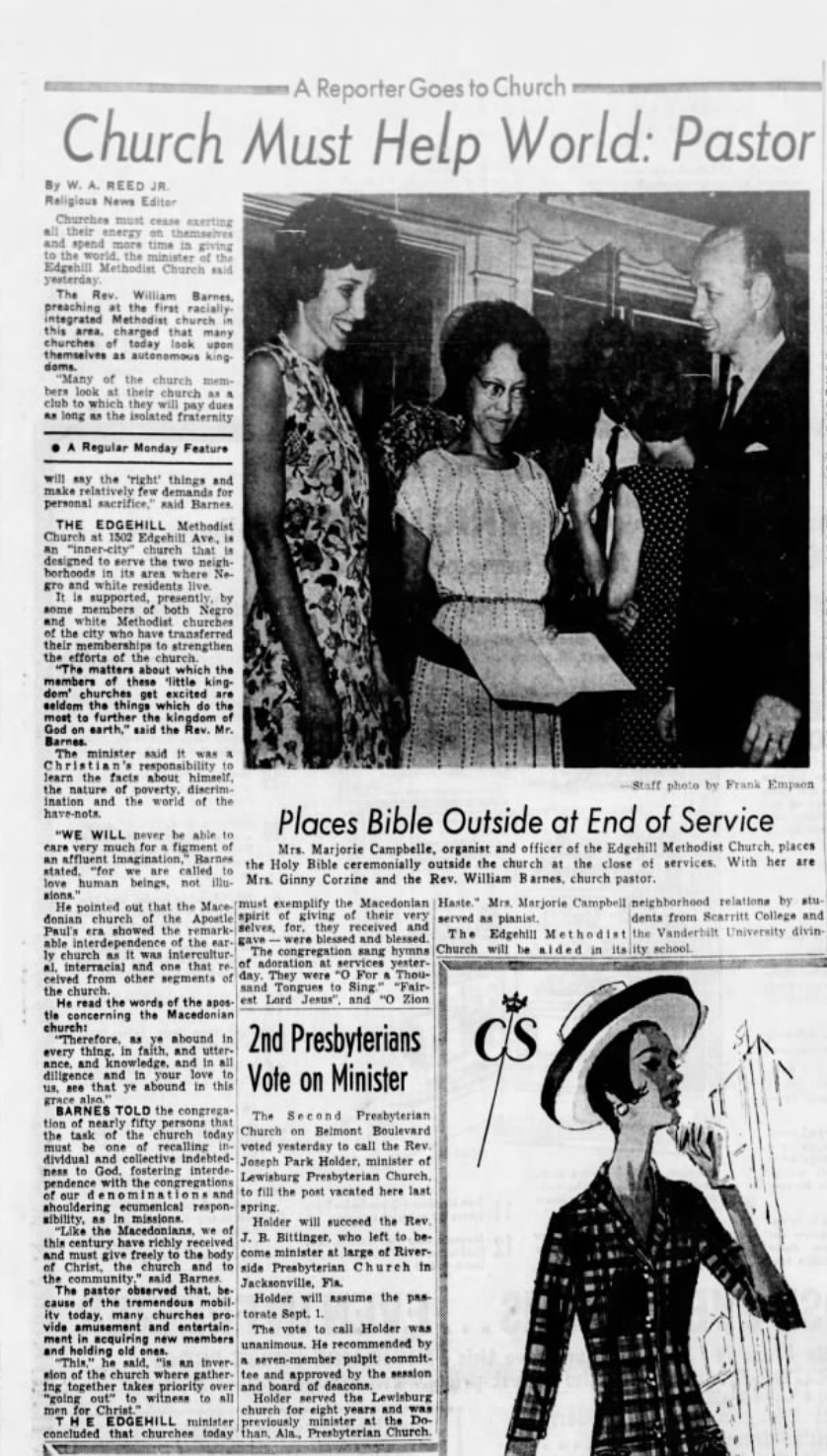
The Nashville Tennessean, July 18, 1966
By W. A. Reed Jr., Religious News Editor
Churches must cease exerting all their energy on themselves and spend more time in giving to the world, the minister of the Edgehill Methodist Church said yesterday.
The Rev. William Barnes, preaching at the first racially integrated Methodist church in this area, charged that many churches of today look upon themselves as autonomous kingdoms.
“Many of the church members look at their church as a club to which they will pay dues as long as the isolated fraternity will say the ‘right’ things and make relatively few demands for personal sacrifice,” said Barnes.
The Edgehill Methodist Church at 1502 Edgehill Ave. is an “inner-city” church that is designed to serve the two neighborhoods in its area where Negro and white residents live.
It is supported, presently, by some members of both Negro and white Methodist churches of the city who have transferred their membership to strengthen the efforts of the church.
“The matters about which the members of these ‘little kingdom’ churches get excited are seldom the things which do the most to further the kingdom of God on earth,” said the Rev. Mr. Barnes.
The minister said it was a Christian’s responsibility to learn the facts about himself, the nature of poverty, discrimination and the world of the have-nots.
“We will never be able to care very much for a figment of an affluent imagination,” Barnes stated. “For we are called to love human beings, not illusions.”
He pointed out that the Macedonian church of the Apostle Paul’s era showed the remarkable interdependence of the early church as it was intercultural, interracial and one that received from other segments of the church.
He read the words of the apostle concerning the Macedonian churches:
“Therefore, as ye abound in everything, in faith, and utterance, and knowledge, and in all diligence, and in your love to us, see that ye abound in this grace also.”
Barnes told the congregation of nearly fifty persons that the task of the church today must be one of recalling individual and collective indebtedness to God, fostering interdependence with the congregations of our denominations and shouldering ecumenical responsibility, as in missions.
“Like the Macedonians, we of this century have richly received and must give freely to the body of Christ, the church and to the community,” said Barnes.
The pastor observed that, because of the tremendous mobility today, many churches provide amusement and entertainment in acquiring new members and holding old ones.
“This,” he said, “is an inversion of the church where rather than going out to take priority over ‘going out’ to witness to all men for Christ.”
The Edgehill minister concluded that churches today must exemplify the Macedonian “haste” spirit of giving of their very selves, for, they received and gave — were blessed and blessed.
The congregation sang hymns of adoration at services yesterday. They were “O For a Thousand Tongues to Sing,” “Fairest Lord Jesus,” and “O Zion Haste.” Mrs. Marjorie Campbell served as pianist.
The Edgehill Methodist Church will be aided in its neighborhood relations by students from Scarritt College and the Vanderbilt University divinity school.